
 Deutsch
 English
Queueing systems with control
In the previous section "Design of queuing systems", an analytical example was used to show the extent to which performance variables of a queueing system, such as the average number of customers in the system, can be influenced by the basic design.
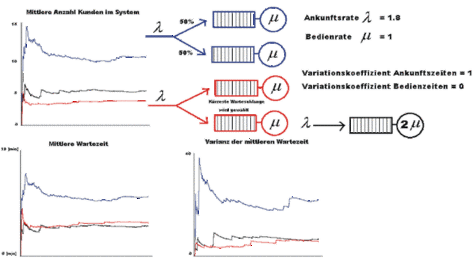
This section will now use a simulation to show that performance variables can be changed or improved by minor control measures in the operating process. For this purpose, three different operating models were generated for the simulation, which can be described in detail as follows:
- Two parallel operators are available. On arrival, the customers are distributed evenly (i.e. 50% per operator) to the queues, regardless of how many customers are already in the queues. This model is referred to as the uncontrolled standard case.
- As in model a), two parallel operators are also available here. However, the customers are divided according to the principle of the shortest queue, i.e. an arriving customer is assigned to the queue with the fewest waiting customers.
This model is referred to as the model with control. - There is only one queue and one operator. However, this operator works at double speed. This model is the reference model that performed most favorably in the previous section.
A simulation run was started with the same parameters as in the last section and allowed to run until the various systems had sufficiently approached their steady state. A comparison with regard to the mean number of customers in the system, mean waiting time and mean variance of the waiting time clearly shows that the inferior uncontrolled system can adapt its performance variables to the reference model using a simple control mechanism and that the mean number of customers in the system even improves beyond the reference value. The drastic improvements can be easily interpreted on the basis of the course of the variance over time. The improvement measure results in queues of the same size and thus uniform waiting times. The variance of the waiting time decreases significantly. Both operators are constantly utilized to 90% capacity in the steady state of the system.