
 Deutsch
 English
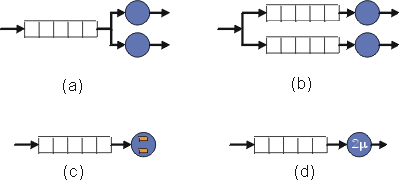
Brief description of the individual systems:
- Two operators are available. The arriving customers are assigned by a so-called dispatcher to the counter that becomes free. This principle is used, for example, to process queues at check-in at the airport
- Here too, two parallel operators are available. However, the customers are distributed equally (i.e. 50% each) between the two queues as soon as they arrive.
- There is only one operator and one queue. However, the operator can serve two customers at the same time
- There is only one operator and one queue. However, the operator works at double speed.
The question arises as to which of these systems is the most favorable in practice. To compare the systems, we use the average number of customers in the system as a performance characteristic.
The following parameters are assumed for the comparison of the performance variables:
| Arrival rate | λ = 1.8, |
| service rate | μ = 1.0, |
| Coefficient of variation of the arrival flow | cl = 1.0, |
| Coefficient of variation of the operating process | cs = 0 |