
 Deutsch
 English
Many models in the natural sciences, but also in financial mathematics, lead to so-called discrete dynamic systems whose long-term behavior and stability can be analyzed using matrices.
We show how eigenvalues (spectrum) and eigenvectors of these matrices determine long-term behavior and stable solutions. After an introduction to the spectral theory of matrices, we study concrete models and applications.
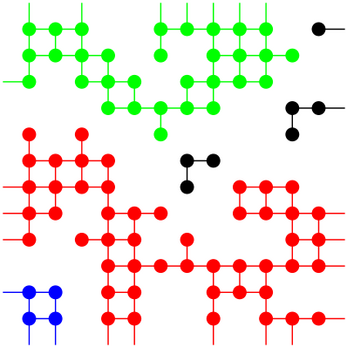
The global properties of real networked structures (e.g. connectivity of cells, permeability of porous media, conductivity of electrical networks) are often determined by random local defects, whose mathematical modeling leads to random graphs (percolation graphs).
We will explain basic graph theoretical concepts and deal with some typical questions that arise when analyzing percolation graphs.
Finally, we will see how the random graphs of a percolation model lead to random matrices, and which relationships between spectrum and percolation result from this.
Program
| 09.30 - 09.45 | Welcome |
| 09.45 - 10.45 | Eigenvalues and dynamical systems (Dr. habil. J. Brasche) |
| 10.45 - 11.15 | Coffee break |
| 11.15 - 12.15 | Percolation and graphs (Dr. habil. M. J. Gruber) |
| 12.15 - 13.30 | Lunch break |
| 13.30 - 14.30 | Eigenvalues and differential equations (Dr. habil. J. Brasche) |
| 14.30 - 15.00 | Coffee break |
| 15.00 - 16.00 | Spectrum and percolation (Dr. habil. M. J. Gruber) |
| 16.00 - 16.30 | Discussion and closing remarks |