
 Deutsch
 English
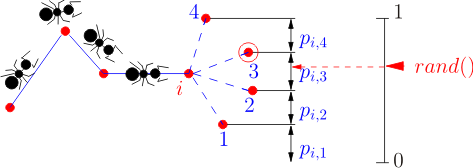
Matrices are used in many areas of application to clearly visualize complicated relationships. In the stochastic variant, they are used to describe random movements ("wrong turns") on a grid; matrix products allow the long-term behavior of such a wrong turn to be predicted. Conversely, aberrations can also be simulated on the computer, and estimates for the matrix products can be obtained from their observation.
In optimization, matrices are used to describe and solve linear optimization problems, which occur in many planning and control problems. Other optimization problems, for example in location or route planning, prove to be very complex and can often only be solved approximately using so-called heuristics. A special heuristic that can be applied to many problems imitates the behavior of ants. Ants find the shortest route between their burrow and a food source ("ant trails") after a few "odysseys". These odysseys can be simulated on the computer (using matrices) and are used, for example, to find the (approximate) shortest route for garbage collection.
In the course of the training, some mathematical principles and approaches for implementation on the computer are presented from this problem area.
Program
| 09.30 - 09.35 | Welcome |
| 09.35 - 10.45 | Matrices and wandering (Prof. Dr. M. Kolonko) |
| 10.45 - 11.15 | Coffee break |
| 11.15 - 12.00 | Matrices in optimization (JProf. Dr. J. Kalcsics) |
| 12.00 - 13.30 | Lunch break |
| 13.30 - 14.15 | When the ice melts . . In search of the optimal location (JProf. Dr. J. Kalcsics) |
| 14.15 - 14.45 | Coffee break |
| 14.45 - 16.00 | Ant algorithms: crawling to success (Prof. Dr. M. Kolonko) |
| 16.00 - 16.30 | Discussion and closing remarks |
Topic
Of matrices and ants
Event KBS241300
Place
Institute of Mathematics at Clausthal University of Technology
Erzstraße 1
38678 Clausthal-Zellerfeld
Time
October 10, 2012
9:30 a.m. to 4:30 p.m.
Speakers
Herr Prof. Dr. M. Kolonko,
Herr JProf. Dr. J. Kalcsics
Contact
Dr. Henning Behnke
Institute of Mathematics
Erzstraße 1
38678 Clausthal-Zellerfeld, Germany
Phone: +49 5323 72-3183
Fax: +49 5323 72-2304
Email: behnke@math.tu-clausthal.de