
 Deutsch
 English
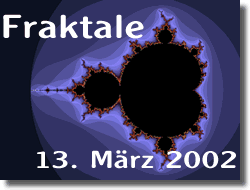
Powerful computers make it possible to carry out iterative algorithms for applications from diverse, often non-mathematical fields (e.g. physics, biology, economics, etc.) in the shortest possible time and then also with "graphical result control". The underlying ideas are the mathematical definition of a dynamic system and - derived from this - the investigation of so-called Limes sets. The well-known Julia sets are just Limes sets of particularly simple systems, which are usually described by means of polynomial or rational functions. The Mandelbrot set can in turn be regarded as a ''map'' of Julia sets of quadratic polynomials. A special case is the calculation of the zeros of a polynomial using the Newton method - the associated Julia set usually corresponds to the starting points that do not converge to a solution. Julia sets are also examples of the fractal sets described in the lecture, although calculating their Hausdorff dimensions is much more difficult.
Program
| 09.30 - 09.45 | Welcome Prof. Dr. W. Klotz |
| 09.45 - 10.45 | Fractal measures and dimension (Prof. Dr. J. Hilgert) |
| 10.45 - 11.15 | Coffee break |
| 11.15 - 12.15 | The mathematics behind computer images - the theory of Julia and Mandelbrot sets (Priv. Doz. Dr. St. - M. Heinemann) |
| 12.15 - 13.30 | Lunch |
| 13.30 - 14.30 | Exercise (Part I) |
| 14.30 - 15.00 | Coffee break |
| 15.00 - 16.00 | Exercise (Part II) |
| 16.00 - 16.30 | Discussion and closing remarks |
Topic
Fractals
Event B404.211.191
Place
Institute of Mathematics at Clausthal University of Technology
Erzstraße 1
38678 Clausthal-Zellerfeld
Time
March 13, 2002
9:30 a.m. to 4:30 p.m.
Speakers
Prof. Dr. J. Hilgert,
Priv. Doz. Dr. St. - M. Heinemann
Contact
Dr. Henning Behnke
Institute of Mathematics
Erzstraße 1
38678 Clausthal-Zellerfeld, Germany
Phone: +49 5323 72-3183
Fax: +49 5323 72-2304
Email: behnke@math.tu-clausthal.de