Deutsch
 English
Extended Erlang-C formula
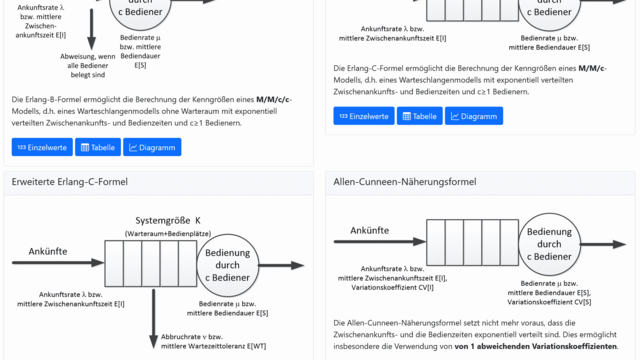
The Erlang C formula was established in the early 20th century by the Danish mathematician Agner Krarup Erlang, to optimize the performance of the then manually occurring telephone connections. While the original Erlang C formula assumes that the clients are willing to wait any length of time, the here offered extended Erlang C formula also respects the impatience of the clients.
In the Erlang model it is assumed that the inter-arrival times of the clients, the service times and the waiting time tolerances of the clients are distributed exponentially. In addition, it is assumed that the system is in steady state.
To calculate the parameters of queuing system, only the arrival rate, the service rate, the average waiting time tolerance and the number of parallel operators has to be specified.
more offers
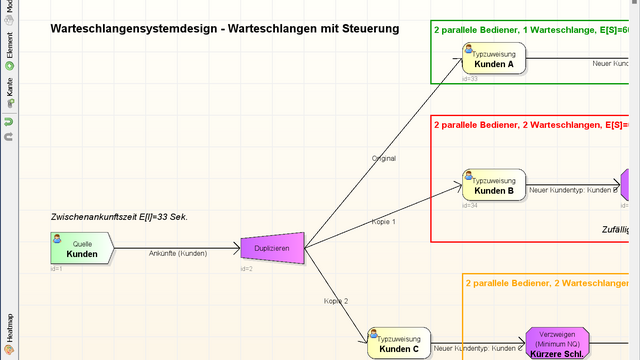
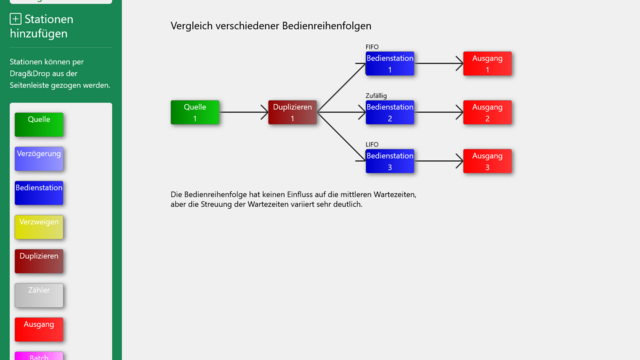
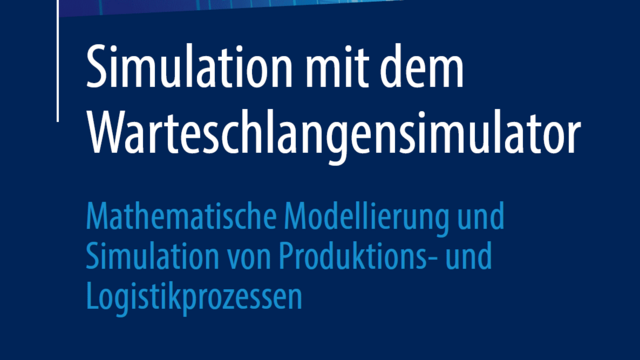
This calculator has only very limited possibilities to represent certain model properties. The Simulation Science Center Clausthal-Göttingen provides a much more extensive queueing calculator with significantly more modeling and evaluation options as a webapp.
Erlang calculator for spreadsheets
The following links can be used to download sample tables and scripts that can be used to calculate the characteristics of common Erlang queueing models:
Criticism of the Erlang-C model
At its time of the early 19th century the Erlang formulas opened the first opportunity to model and calculate queueing processes analytically. However, the formulas do not take into account many of the relevant properties today:
- The exponential distribution is used for the distribution of the service times which usualy is not very realistic.
- The exponential distribution is used for the distribution of the waiting time tolerances which usualy is not very realistic.
- It is assumed that the system is in steady state, i.e., that the arrival rate does not change.
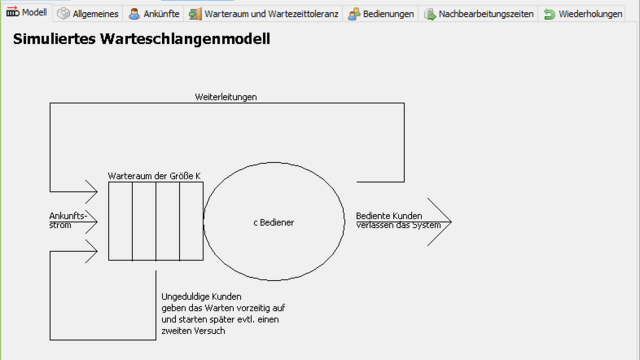
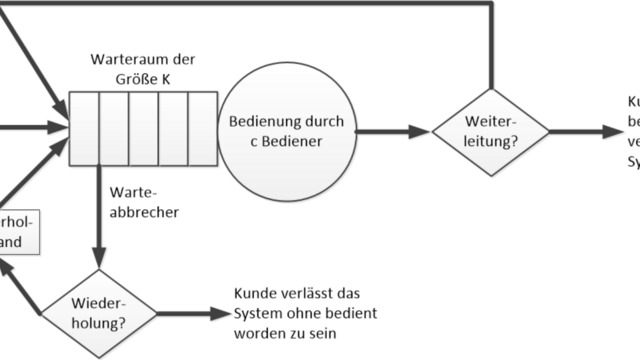
- Customers who start a repeated attempt after a waiting cancelation are not mapped in the model.
- More complex features, such as different types of customers (and the resulting possibly of multi-skill agents), forwarding, post processing times of the agents, prioritization strategies, etc. are not mapped.
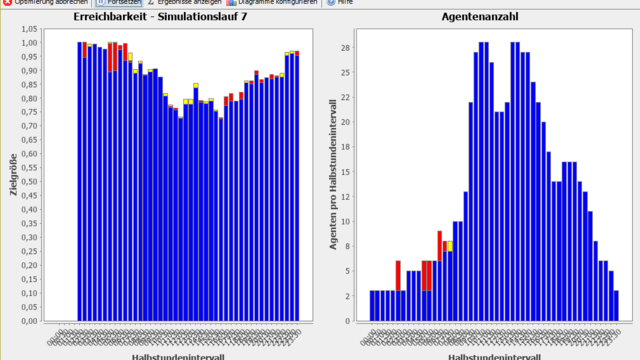
To meet these new demands, the analysis and optimization of queueing systems is now mostly done using simulation methods.