
 Deutsch
 English
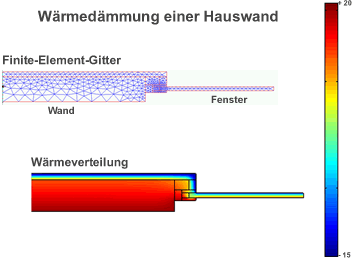
The modeling of many technical but also increasingly economic problems leads to (mainly partial) differential equations. The buzzword "simulation" often used today - in the sense of predicting technical or economic processes - usually means nothing more than solving differential equations on the computer.
Expensive experiments are replaced by inexpensive numerical calculations. For a large class of differential equations, the finite element method can be used for their approximate solution. In the training course, the mathematical principles of the method will be explained using simple examples and its efficiency will be illustrated using some more complex problems with partial differential equations.
Program
| 09.30 - 09.45 | Welcome Prof. Dr. W. Klotz |
| 09.45 - 10.45 | Simulation - Introduction to the Finite Element Method, Mathematical Basics I (Dr. H. Behnke) |
| 10.45 - 11.15 | Coffee break |
| 11.15 - 12.00 | Mathematical Foundations II (Dr. H. Behnke) |
| 12.00 - 13.15 | Lunch break |
| 13.15 - 14.30 | The path to the discrete: From natural phenomena to numerical methods (Prof. Dr. L. Angermann) |
| 14.30 - 15.00 | Coffee break |
| 15.00 - 16.00 | From the idea to the program: The implementation of the FEM (Prof. Dr. L. Angermann, Dr. H. Behnke) |
| 16.00 - 16.30 | Discussion and closing remarks |
Topic
Simulation – Introduction to the Finite Element Method
Course B404.312.191
Place
Institute of Mathematics at Clausthal University of Technology
Erzstraße 1
38678 Clausthal-Zellerfeld
Time
March 19, 2003
9:30 a.m. to 4:30 p.m.
Speakers
Prof. Dr. L. Angermann,
Dr. H. Behnke
Contact
Dr. Henning Behnke
Institute of Mathematics
Erzstraße 1
38678 Clausthal-Zellerfeld, Germany
Phone: +49 5323 72-3183
Fax: +49 5323 72-2304
Email: behnke@math.tu-clausthal.de