
 Deutsch
 English
In the training course, two "users" will first talk about the importance of mathematics in their discipline. Then the Managing Director of KOMMS, the competence center for mathematical modeling in STEM projects in schools, will speak. In addition to project work with pupils and further education and training, the center is now also increasingly involved in research in the field of mathematical modeling from a didactic perspective.
Prof. Dr.-Ing. Stefan Hartmann, Clausthal University of Technology, Institute of Engineering Mechanics
Mathematics in Engineering Mechanics
This article shows the importance of mathematics in engineering studies, in particular research in engineering mechanics, continuum mechanics and computational mechanics. The influence of analysis and algebra is shown. Applications conclude the presentation.
Prof. Dr.-Ing. Hubert Schwarze, Clausthal University of Technology, Institute of Tribology and Energy Conversion Machines
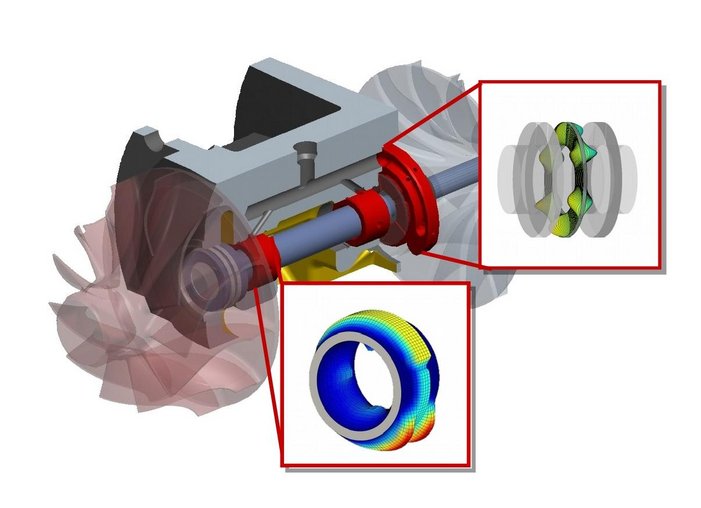
Tribology meets Numerics
The increased power density in the field of computer hardware makes it possible to investigate many processes simulatively in advance and thus to estimate the quality of research results in a time-effective manner. In the field of tribology, which deals with phenomena in lubricated friction systems (e.g. modern motors), the Navier-Stokes equations are generally used to describe flow phenomena. The temperature dependence of the processes is taken into account by additional (partial) differential equations for the energy conversion. By making a few simplified assumptions, it is possible to calculate characteristic values for predicting the operational reliability of lubrication gap sizes, such as maximum pressure, lubricant flow rates or minimum lubrication gap widths. The numerical solution of the differential equations requires a sound knowledge of numerical mathematics to solve the engineering problems.
Dr. Martin Bracke, Technische Universität Kaiserslautern
Mathematical modelling and research-based learning - challenges and opportunities
There is a lot of literature on mathematical modelling and there are questions with associated material for a great deal of school mathematics content, which take up specific content and suggest it for students to work on. On the other hand, we are surrounded by numerous exciting new questions that initially represent unknown territory and for which mathematical modeling offers itself as a very useful and powerful tool on the way to a solution. If one wants to keep the approach to such a problem and the choice of mathematical tools very open, several challenges arise: It is not clear per se which tool is the most favorable and without a certain amount of experience, it is sometimes not even possible to estimate complexity and time requirements well. In everyday school life, these are good arguments for excluding a very open approach that is not geared towards specific mathematical content in advance. On the other hand, the work form of inquiry-based learning opens up completely new learning potential when solving such open-ended problems - especially with regard to core mathematical skills. After an introduction, the workshop will present practical examples from STEM project work in lower and upper secondary schools, with the opportunity to conduct your own small experiments. Finally, organizational aspects and the important component of suitable support for pupils will also be considered.
Program
| 09.30 - 09.45 | Welcome |
| 09.45 - 10.45 | Mathematics in engineering mechanics (Prof. Dr.-Ing. Stefan Hartmann) |
| 10.45 - 11.15 | Coffee break |
| 11.15 - 12.15 | Tribology meets Numerics (Prof. Dr.-Ing. Hubert Schwarze) |
| 12.15 - 13.30 | Lunch break |
| 13.30 - 14.30 | Challenges and opportunities, part 1 (Dr. Martin Bracke) |
| 14.30 - 15.00 | Coffee break |
| 15.00 - 16.00 | Challenges and opportunities, part 2 (Dr. Martin Bracke) |
| 16.00 - 16.30 | Discussion and closing remarks |
Registration and material download
User registration
Please enter the access data provided on the teacher training course in order to access the materials for this course.
Insert registration field
Topic
Mathematics: Modeling and Simulation
Course KBS811040
Place
Institute of Mathematics at Clausthal University of Technology
Erzstraße 1
38678 Clausthal-Zellerfeld
Time
March 14, 2018
9:30 a.m. to 4:30 p.m.
Speakers
Herr Prof. Dr.-Ing. Stefan Hartmann,
Herr Prof. Dr.-Ing. Hubert Schwarze,
Herr Dr. Martin Bracke
Contact
Dr. Henning Behnke
Institute of Mathematics
Erzstraße 1
38678 Clausthal-Zellerfeld, Germany
Phone: +49 5323 72-3183
Fax: +49 5323 72-2304
Email: behnke@math.tu-clausthal.de