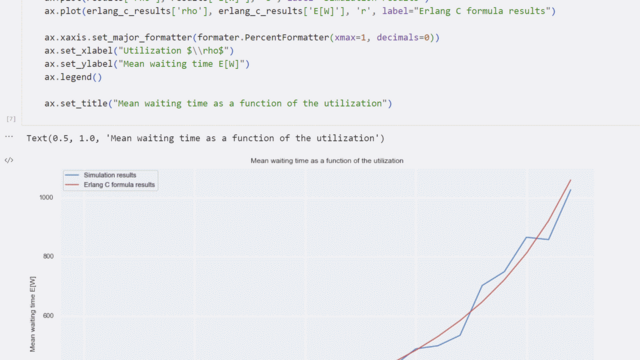
Simulation of a M/G/1 queue

The inter-arrival times of the customers are exponentially distributed, the distribution for the service times can be selected to be gamma distribution, exponential distribution and log-normal distribution. In the case of the exponential distribution this results in an M/M/ 1 queue.

At the bottom of the page the parameters of the inter-arrival and service time distributions can be adjusted. The ratio of service and the arrival rate defines the traffic rate.

In the diagram the number of clients in the system at time t is specified. Each jump upwards defines a customer arrival, each jump to the bottom means the end of a service time. The service time are also denoted below.
Simulation software

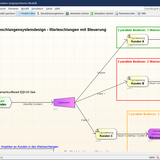
Clausthal University of Technology offers a range of simulation programs via the Simulation Science Center. These are all open source programs that can be used free of charge:

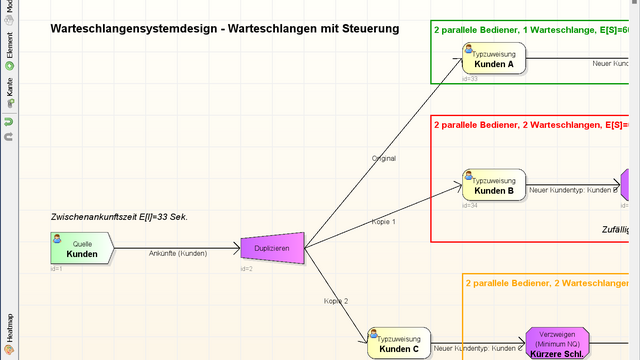
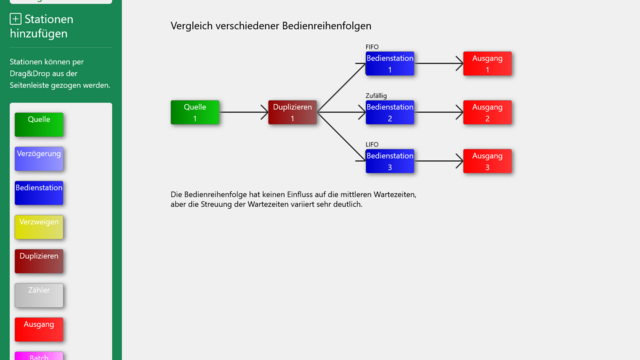
Queueing simulator

Open source Java application for modeling and simulating complex queueing networks

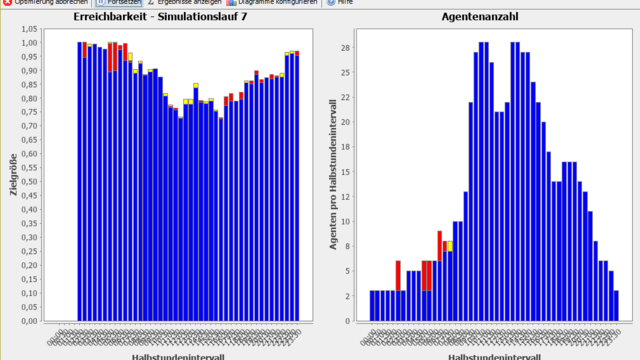
Call center simulator

Open source Java application for analyzing and optimizing complex call center networks consisting of several sub-call centers and several caller groups

Mini call center simulator

Open source Java application for simulating simple queueing models

Mini Queueing Simulator

Open source web application for modeling and simulating queueing networks

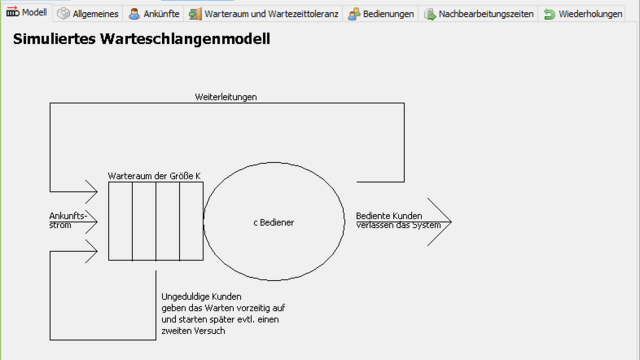
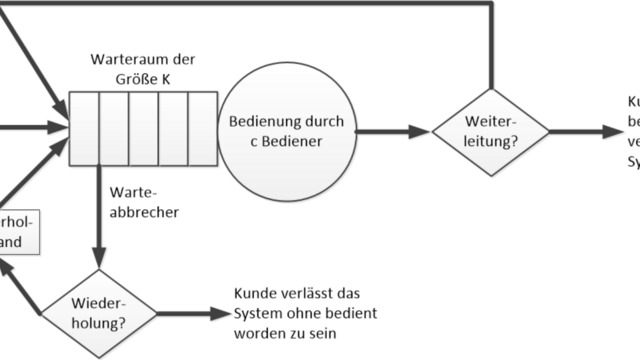
G/G/c/K+G Simulator

Open source web app for simulating G/G/c/K+G queueing models

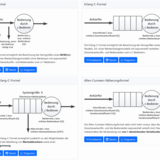
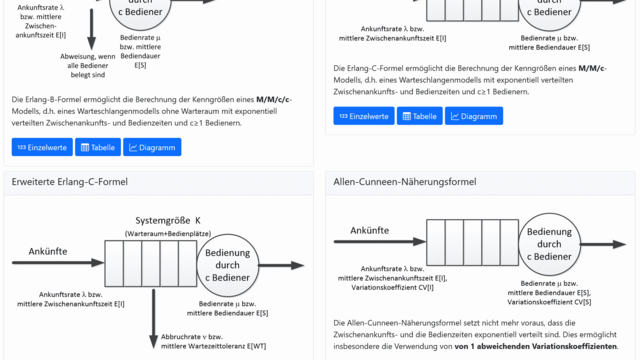
Queueing Calculator

Open source web application for calculating the parameters of various queueing models (Erlang-B, Erlang-C, Pollaczek-Chintschin, Allen-Cunneen)

QueueSim (Python)

Open source Python library (including examples in the form of Jupyter notebooks) for creating simulation models in Python