Deutsch
 English
Numerical integration
Although one has the impression that the integration is the counterpart of differentiation, integration is much more difficult. To determine derivatives of specific functions, it is sufficient to apply a few defined rules. To integrate elementary functions, however there is no easy and not all cases a concealing algorithm. Here you are much more likely to rely on numerical approximations. Numerical integration is also called quadrature.
Rectangle rule
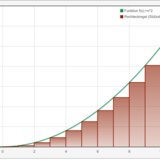
This is the simplest form of approximation. The function graph is approximated using a single point (n=1), and the area is approximated as a rectangle. In the multiple rectangle rule (n>1), the region of integration is divided into subintervals, and the above rule is applied to each subinterval.
This is the simplest form of approximation. The function graph is approximated using a single point (n=1), and the area is approximated as a rectangle. In the multiple rectangle rule (n>1), the region of integration is divided into subintervals, and the above rule is applied to each subinterval.
Trapezoidal rule
The basic idea here is to use two points of support to approximate the function graph with a straight line and, consequently, the area with a trapezoid. In the multiple trapezoidal rule (n > 1), the region of integration is divided into subintervals, and the above rule is applied to each subinterval. In this case, function evaluations can be reused, since each inner point of support belongs to two trapezoids.
The basic idea here is to use two points of support to approximate the function graph with a straight line and, consequently, the area with a trapezoid. In the multiple trapezoidal rule (n > 1), the region of integration is divided into subintervals, and the above rule is applied to each subinterval. In this case, function evaluations can be reused, since each inner point of support belongs to two trapezoids.
Simpson's rule / Kepler's barrel rule
Here, the function is approximated by a quadratic polynomial. To do this, both endpoints and the midpoint are used as control points. In the compound Simpson's rule (n > 1), the integration region is divided into subintervals, and the above rule is applied to each subinterval. Here, too, function evaluations can be reused, since the endpoints usually belong to two intervals.
Here, the function is approximated by a quadratic polynomial. To do this, both endpoints and the midpoint are used as control points. In the compound Simpson's rule (n > 1), the integration region is divided into subintervals, and the above rule is applied to each subinterval. Here, too, function evaluations can be reused, since the endpoints usually belong to two intervals.